
Open-Ended Toys: Why They Matter and Our Top Picks for 2026
Tired of toys your kid plays with for a week and then ignores forever? Open-ended toys are the antidote — and they're worth every penny.
If you've ever bought a flashy battery-powered toy that your toddler abandoned within days, you're not alone. Most parents have experienced the same cycle: the buzz of unwrapping, a few minutes of attention, and then it's tossed aside while your kid plays with the cardboard box it came in.
There's a reason for that. The toys that hold a child's attention longest aren't the ones that do the most. They're the ones that let the child do the most.
Welcome to open-ended toys.

What Are Open-Ended Toys?
Open-ended toys don't have a single right way to play with them. There are no instructions, no specific outcomes, no flashing lights telling your kid what to do next. The child decides what they are, what they do, and how they're used.
A wooden block can be a phone, a piece of cake, a car, or part of a giant tower. A magnetic tile can be a roof, a wall, a mirror, or a pizza. A play kitchen can be a restaurant, a science lab, or a coffee shop. Each play session is different because the imagination is the engine.
Compare that to a toy that talks, sings, or shows pre-recorded animations on a screen. The toy is doing the playing. Your child is just watching.
Why Open-Ended Toys Are Worth the Investment
There's growing research that play-based learning develops critical thinking, creativity, and problem-solving in ways that scripted toys simply can't.
A few specific benefits parents notice:
Longer attention spans. Open-ended toys grow with the child. A magnetic tile set bought for a 2-year-old will still be played with by the same kid at age 7 — just in totally different ways.
Less clutter. When toys can serve multiple purposes, you need fewer of them. A handful of high-quality open-ended toys often replaces a closet full of single-purpose plastic.
More independent play. Kids playing with open-ended toys often play longer without parental involvement. They're inventing rather than executing.
Stronger imagination. Open-ended play forces kids to fill in the gaps. Over time, that becomes a creative muscle they use everywhere — at school, with friends, in problem-solving.
Better long-term value. A $50 toy that gets played with daily for 5 years costs less per use than a $20 toy abandoned in 2 weeks.
Our Top Open-Ended Toys for Toddlers
Here are the toys we recommend for ages 2-6, organized by play style:
1. Magnetic Tiles
The reigning champion of open-ended play. Magnetic tiles can become buildings, vehicles, mosaics, marble runs, ramps, garages, fairy houses, or anything else a kid can imagine. They work for kids as young as 18 months (under supervision) and continue being engaging well into elementary school.
Why we love them: They scale beautifully with age. A 2-year-old stacks them in towers. A 4-year-old builds 3D castles. A 7-year-old builds elaborate marble run systems with ramps and tunnels.
Shop Square House Magnetic Tiles →

2. Wooden Play Kitchen
A play kitchen is a stage for endless pretend play. Cooking, hosting tea parties, running restaurants, opening coffee shops — every game starts here. Bonus points if it has a working sink, which adds real water play to the mix and dramatically extends the play time.
Why we love them: Pretend play is foundational for emotional development, language skills, and social play. A play kitchen gives kids a space to practice all of it.
Shop Square House Play Kitchen →

3. Wooden Blocks
Don't underestimate the humble wooden block. Blocks teach physics, balance, problem-solving, and patience. They become buildings, food, currency, animals, vehicles, and abstract art. Every era of childhood includes blocks for a reason — they work.
Why we love them: Affordable, durable, and infinitely versatile. Pair them with magnetic tiles for next-level play.
4. Magnetic Race Tracks
A magnetic race track is essentially a building toy disguised as a vehicle toy. Kids design custom tracks, race cars through them, knock them down, and rebuild differently next time. It combines spatial reasoning, fine motor skills, and creativity in one play experience.
Why we love them: Combines two play categories (building + racing) which doubles the play scenarios. Kids who love cars and kids who love construction both engage deeply.
Shop Square House Magnetic Race Track →

5. Marble Run
Marble runs are pure problem-solving. Kids build, test, fail, redesign, and try again. The "will it work?" tension keeps them engaged for hours. Once they nail a working track, they immediately want to make it more complex.
Why we love them: Engineering skills disguised as play. Kids who play with marble runs develop intuitive understanding of physics and gravity.
6. Play Silks or Scarves
The simplest open-ended toys are sometimes the best. A few large silk scarves become capes, picnic blankets, ocean waves, doll bedding, fort coverings, or anything imaginable. They're light, washable, and pack flat.
Why we love them: Ultra-low cost, ultra-high play value. Especially good for kids who love imaginative role-play.
7. Animal Figurines & Small World Sets
Realistic animal figurines (Schleich, CollectA, etc.) become the cast of countless stories. Combine them with magnetic tiles, blocks, and play silks for full small-world play setups — farms, jungles, zoos, oceans.
Why we love them: Perfect for narrative-loving kids who tell elaborate stories. Pairs with literally everything else on this list.
8. Indoor Trampoline
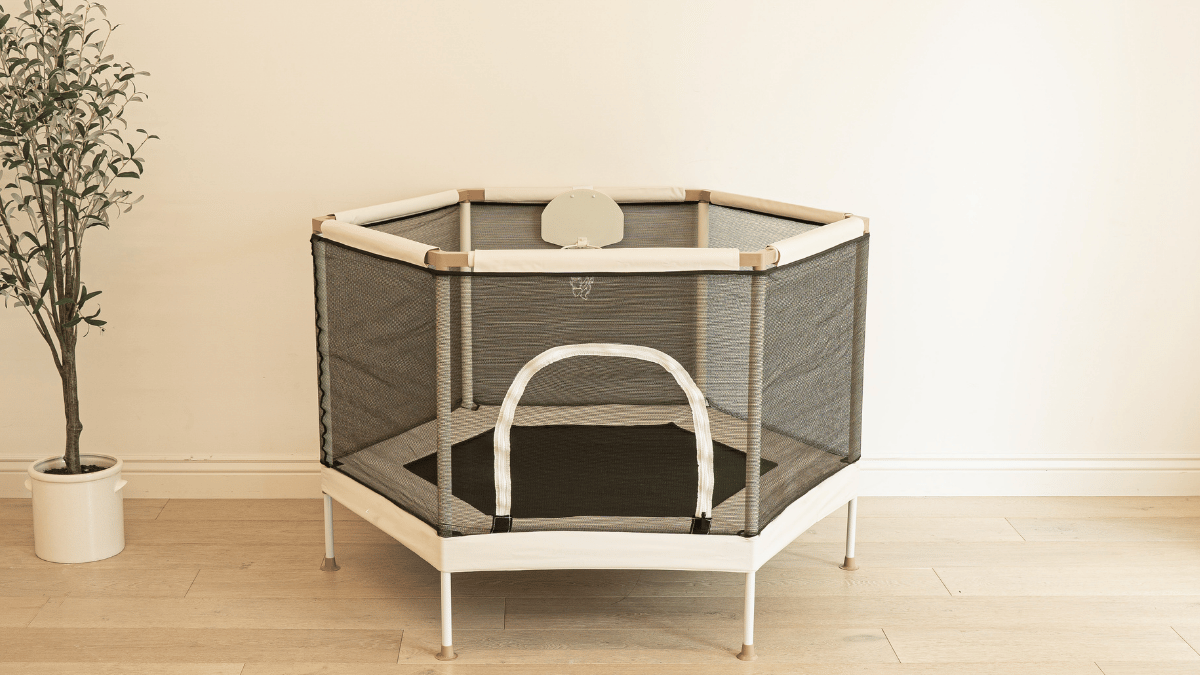
Hear us out. A small indoor trampoline is open-ended in a different way — kids invent jumping games, basketball challenges, jumping-and-throwing combos, and use it as a stage, fort, or quiet bouncing time. It's a movement-based open-ended toy that's a lifesaver on rainy days.
Why we love them: Burns energy AND lets kids invent their own games. Stack it with stuffed animals, balls, and rules they make up.
Shop Square House Trampoline →

9. Pretend Play Food & Tea Sets
Wooden or silicone tea sets, food, and serving dishes turn any space into a restaurant, café, or fancy dinner party. They pair perfectly with the play kitchen and extend the pretend play repertoire.
Why we love them: Encourages social play, language development, and turn-taking. Kids "serve" stuffed animals, siblings, and parents endlessly.
10. Open-Ended Loose Parts
This is more of a category than a single toy — it includes things like wooden rings, large wooden coins, smooth river rocks, glass gems, large buttons, or dried natural items like pine cones and seashells. Kids sort, stack, count, arrange, and incorporate them into all their other play.
Why we love them: Inexpensive (or free!) and endlessly versatile. Great for sensory play and pattern-making.
What to Look for When Choosing Open-Ended Toys
A few criteria that separate great open-ended toys from forgettable ones:
Quality construction. A toy that breaks in three months wasn't a deal at any price. Look for solid wood, durable plastic, and reinforced joints.
No batteries or screens. If it requires electricity, it's probably doing the playing for the child.
Multiple use cases obvious from a glance. Can you imagine 5+ ways to play with it? Good. If not, skip it.
Aesthetic that fits your home. Toys that live in shared family spaces should look like they belong there. Neutral, modern designs blend in. Bright primary colors don't.
Safety certifications. ASTM safety testing is the standard for kids' toys in the US. Verify it.
Ages 2+ rather than super specific age ranges. Open-ended toys should grow with the child. If it's only useful for ages 3-4, it's probably not very open-ended.
How to Encourage Open-Ended Play at Home
Buying the toys is step one. Setting up the environment matters too:
Less is more. Rotate toys instead of having them all out at once. Kids engage more deeply with fewer choices.
Don't direct the play. Resist the urge to show your child "the right way" to use a toy. Let them figure it out.
Combine toys. The magic happens when magnetic tiles meet animal figurines meet wooden blocks meet play silks. Encourage cross-pollination.
Create invitations to play. Set out a few open-ended materials in an inviting way (a basket of blocks next to a few cars, for example) and watch the imagination kick in.
Play with them sometimes. Modeling creative play helps kids who aren't sure how to start.
The Long Game
Open-ended toys are an investment in your child's developing mind. They build creativity, focus, problem-solving, and confidence in ways that no scripted toy can match.
They also reduce clutter, save money in the long run, and keep your kid genuinely engaged for years. That's a parenting win on every level.
Whether you're just starting to build your toddler's toy collection or trying to fix a toy room full of forgotten plastic, start here. A small, well-chosen library of open-ended toys is worth more than a closet full of anything else.
Browse all Square House products →